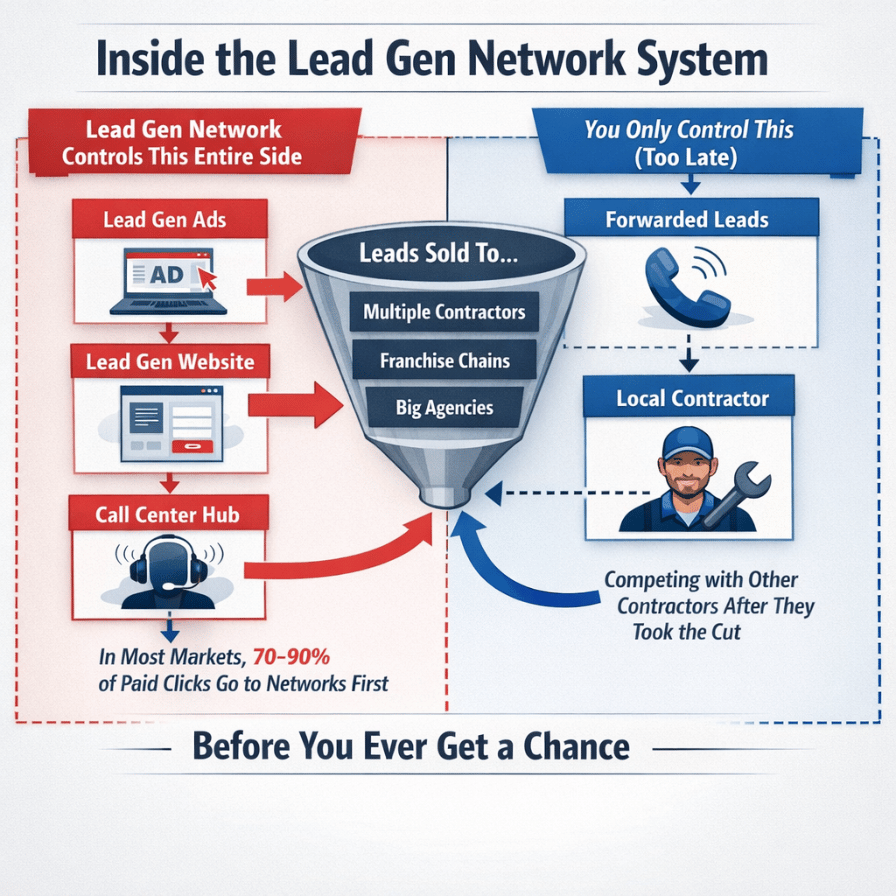
In the last two posts, we covered what's actually happening in garage door markets and how lead-gen networks are capturing your calls.
Now we're getting into the fix.
Not theory. Not generic marketing advice.
A specific system — built around how garage door leads actually move.
The Non-Obvious Insight Most Companies Miss
Here's what the data shows when we audit garage door markets:
Most companies are investing in the wrong channel — and ignoring the one that drives the most leads.
The actual lead hierarchy looks like this:
- Google Maps / Google Business Profile (GBP) — #1 lead driver
- Google Ads (LSA + PPC) — #2
- Organic SEO — #3 (supporting, not primary)
Most companies do the opposite.
They pour money into SEO. They ignore their GBP. They wonder why the phone isn't ringing.
This isn't a theory. It's visible in every SERP audit we run on local garage door markets.
The Three-Part Growth System
Once you understand the lead hierarchy, you build around it.
The system has three parts. They reinforce each other — but they're not equal.
Part 1: Website = Conversion Engine (Not a "Presence")
Here's the mindset shift that changes everything:
Your website is not for ranking. It's for converting.
Traffic comes from Maps and Ads. Your website's job is to turn that traffic into calls, quotes, and booked jobs.
That means it needs to be built like a conversion machine — not a digital brochure.
Above the Fold (What They See Before Scrolling)
This is the most important real estate on your site. Get it wrong and the visit is over in 3 seconds.
- Clear offer: "Free Quote" or "Same Day Service" — visible immediately
- Click-to-call button: tappable on mobile, prominent on desktop
- Lead form: short, simple, above the fold or one scroll away
- Chat widget: optional, but measurably increases lead volume when installed correctly
Trust Stack (What Makes Them Stay)
People don't call strangers. They call businesses they believe.
Your site has to build that belief fast.
- Real photos — not stock images. Job sites, your team, your trucks.
- Owner or team visibility — a short video or a face builds trust faster than any headline
- Reviews embedded on the page — not just a "check our Google reviews" link
Content Sections (What Supports the Decision)
After trust is established, visitors look for confirmation.
- Services — clearly listed, with descriptions
- Project gallery — real work, real photos
- About / credibility — why you, how long, what you stand for
- Location info — where you serve, embedded map
Footer (Highly Overlooked)
A lot of garage door sites have broken or empty footers. This is a missed conversion point.
- Phone number — always visible
- Hours — people check this before calling
- Address — legitimacy signal
- Embedded Google Map
- Quick navigation links
The Scaling Component: City Service Pages
This is where most companies leave serious growth on the table.
If you serve multiple cities, you need a dedicated page for each one.
Not a template with the city name swapped in.
Actual, localized pages.
What a real city page includes:
- Local references — neighborhood landmarks, common weather issues, area-specific context
- Localized service descriptions — same services, written for that city's homeowner
- Full conversion elements — click-to-call, form, trust signals — everything from the homepage
Think of each city page as:
A mini homepage built specifically for that city.
Bad approach: duplicate content with the city name swapped out.
Correct approach: fully localized pages that feel written for that specific market.
This is where organic SEO starts to compound — city by city, over time.
Part 2: Google Business Profile = Your Lead Engine
If you do nothing else from this article, fix your GBP.
It is, by a wide margin, the highest-ROI activity available to most local garage door companies.
And most profiles are severely under-optimized.
How the Algorithm Works
GBP ranking is signal-based. Google is measuring activity, relevance, and trust — constantly.
The top ranking factors:
- Reviews — the dominant factor, by a significant margin
- Activity — posts, photo uploads, Q&A responses
- Local relevance signals — service areas, categories, keywords in your profile
- Engagement — clicks, calls placed, direction requests
Reviews Are Fuel
Not optional. Not something you do once and forget about.
The system requires continuous, ongoing review acquisition.
- Volume matters
- Recency matters even more
- One review a month beats a one-time push of 20 followed by nothing
"Everything works worse without reviews."
Ads are less effective. Maps rankings drop. Website traffic converts at a lower rate.
Reviews are the connective tissue of the whole system.
Weekly GBP Operations
Consistency signals activity to the algorithm. Here's what the weekly rhythm looks like:
- Post at least once — a completed job, a tip, a seasonal offer, anything relevant
- Upload new photos — job site photos, team photos, before/afters
- Respond to all reviews — positive and negative, within 48 hours
- Answer any Q&A entries — keep the profile active and accurate
- Check for suggested edits — Google allows the public to suggest changes; review them
This isn't glamorous work. But it compounds.
The companies that do this consistently are the ones showing up at the top of Maps — not the ones who "set it and forgot it."
Part 3: Google Ads (LSA + PPC) = Amplifier
Ads come third — not because they're less important, but because they amplify what's already working.
Running ads to a weak website and a thin GBP profile is expensive and inefficient.
Running ads to a conversion-optimized website and a strong GBP profile is a different experience entirely.
LSA (Local Services Ads)
These appear above everything else in Google — above regular ads, above Maps, above organic.
They're pay-per-lead, not pay-per-click. And the ranking is partly tied to your GBP strength and reviews.
This is another reason reviews aren't optional.
PPC (Pay-Per-Click)
Targeted search ads for high-intent queries: "garage door repair [city]", "broken spring replacement", "same day garage door service."
The key is matching the ad to a landing page that converts — not just sending traffic to the homepage and hoping.
How the System Fits Together
The three parts aren't independent levers. They're a system.
- Your website converts the traffic that Maps and Ads send
- Your GBP drives organic Maps leads and strengthens your LSA ranking
- Reviews fuel both your GBP ranking and your website's credibility
- City pages expand your organic footprint without paying for additional ads
- Ads fill gaps and scale what's already working
When all three are running together, growth compounds.
When one is broken, the others underperform.
Where Most Companies Are Right Now
Based on real audits of garage door companies across Florida markets, the typical picture looks like this:
- Website: weak above-the-fold, minimal trust signals, no city pages
- GBP: incomplete profile, sporadic reviews, no ongoing activity
- Ads: running, but pointed at an unconverted homepage
The result: leads that should be theirs are going to lead-gen networks instead.
Not because the competition is better at doing garage doors.
Because they're better at capturing demand.
What to Do Next
Start with an honest audit of where you actually stand:
- What does your homepage look like to a cold visitor on mobile?
- When did you last get a Google review — and was it more than 30 days ago?
- Do you have city-specific pages for every market you serve?
- Are your ads sending traffic to a page that's designed to convert?
Most companies who go through this exercise find obvious gaps immediately.
The good news: most of those gaps are fixable without a massive budget.
If You Want a Second Set of Eyes
We've been auditing garage door companies across local Florida markets — breaking down exactly where leads are being lost and what would move the needle fastest.
If you want to see where you stand, we'll show you.
No fluff. No generic advice. Just a clear view of your market and what to fix first.